"The Incredible Journey"
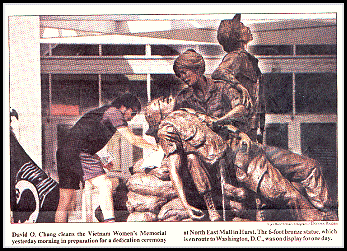
Photo Courtesy of the Fort Worth Star Telegram - Donna Bagby
Caption Reads: "David O. Chung cleans the Vietnam Women's Memorial yesterday [1993]
morning
in preparation for a dedication ceremony at North East Mall in Hurst.
The 6-foot bronze
statue, which is en route to Washington, D.C., was on display for one day."
Member Profile: David Chung
By Joseph Cerquone
The VVA Veteran -- January 1994
The president of VVA Chapter 285, Crown Point, Indiana, is talking about the nurse who came to his aid after he caught some shrapnel while serving as an airman at Bien Hoa.
Chung wasn't badly hurt--in body. The American-born GI of Chinese descent had only minor ear and leg wounds. But barred admission by MPs who suspected his Asian looks and thought he had stolen his own uniform, Chung was in the midst of taking a huge hit of another kind when an anonymous nurse rose to his defense, got him through security, and provided care.
"She saw me as a person," he recalls.
How fitting it was then that she came to mind frequently a few months ago as Chung drove a truck from Santa Fe to Wichita, from Indianapolis to Jersey City. For back in the cargo bay sat the new Vietnam Women's Memorial, a sculpture with bronzed replicas of the unforgettable nurse, an individual who was among the few during the war for whom Chung's Asian features didn't matter. This VVA leader had a job of transporting the monument, a tribute to the nearly 12,000 women who served in Vietnam, on a multi-city tour prior to its recent dedication in Washington.
"Asian-American [military] contributed and sacrificed," David Chung says. "Nine-hundred Orientals are on the Wall, and two Asians won Medals of Honor."
Growing up, Chung might have expected such a legacy. Though he was raised in Chicago by immigrant parents, he felt as much a part of this country as anyone else. And until he entered a war zone as a young man, there was no evidence to think another American would see him as the enemy.
Chung recollects that some schoolyard hassles erupted here and there, sparked by animosity towards his heritage. But they didn't prepare him for the discrimination he found in Vietnam in the early 1970s.
"Asians like me were the targets of the worst hatred Americans had," Chung says, noting how frustration among troops mounted as casualties increased and the purpose of the war became muddled. "I always had to prove myself--prove I was American. I got so tired of being called 'gook' and 'Charlie.' "
But the ill will was about much more than harassing police and epithets. In Vietnam, those who discriminated were armed and moved in a negative, bitter environment. Chung constantly feared one of his own men might try to kill him.
"People could blow you away and say, 'I thought he was a gook.' There would have been no questions asked." He adds that other Asian-American veterans had similar experiences and have felt compelled to go "in the closet," where they remain.
"I was surprised when David started telling me about the discrimination he faced" says Cheryl German-Chung. "But then I felt stupid for failing to realize that sort of thing went on." German-Chung, a nurse in Vietnam, says her husband has had the past catch up with him sometimes at veteran functions. The couple married a few years ago after meeting at a VVA leadership conference.
"He has been introduced as an 'NVA who came to our side,' and as 'Our token Oriental,' " she says. But such remarks have not dampened her mate's commitment. "Involved, considerate, concerned, energetic, knowledgeable," as German-Chung describes him. "He is a people person. Get him with vets, and it is hard to separate them."
Chung realizes that his honesty and forthrightness could anger those who won't admit racism ever existed. But he says education, not making people mad, is his intent. The discrimination was "normal because of how troops were trained and how the war was going," he says; offenders were tangled up in something not of their doing.
Recognize the facts, Chung encourages, but don't lay blame, especially on grunts who were made to bear the brunt of the war. "When I talk about this with vets, I make a point to say they should not feel guilty."
Chung was not in a magnanimous mood when he returned from Vietnam, however. Embittered by the mistreatment there, he was also frustrated by the long reach of misunderstanding. How nuts was it to be an Asian-American veteran? Very, Chung says. People acted like he was a "crazed veteran, a stupid 'gook', or a refugee." He ran into some of this when he applied for a position helping the thousands of Vietnamese who were fleeing their country.
"I was asked what province I was from," Chung recalls. "Then, when I explained who I was, I was told the job was for Orientals only. I freaked out. I didn't know what to say."
Things changed, but slowly. After he noticed a truck belonging to Federal Express, a company started by fellow veteran Fred Smith, Chung decided to seek a driving job. The outfit was so new then, interviews were quite unorthodox.
"I met someone in an empty parking lot. For our talk he pulled a Federal Express sign from his car and hung it on a phone booth, saying 'This is our office.' "
Chung had no way of knowing that the unusual session would lead to a very stable work history; this year marked his eighteenth as a "Fed Ex" driver. And if his memory of that nurse who stepped forward to help him was a primary motivation for his part with the women's memorial, the expertise Chung has gained at work gave him the confidence to tackle the role. Furthermore, Chung's strong interest prompted Federal Express to provide the project with its transport vehicle, fuel, and loading and packing equipment.
What is hauling a monument to history like? A mix of hard work and unforgettable scenes. The sculpture was shown the whole way east, a fact which put Chung and Chuck Raphael, another veteran and driver, into a month-long routine of rising at dawn, setting up at display and civic ceremony sites, then spending hours re-packing before moving on. Usually, they would drive late in order to have enough set-up time for the next round of activities.
Chung, 43, lost sleep and weight, going from 165 to 154 pounds.' "It was pretty grueling," he says. "We hit a new city every day."

Memorial en route to Wash. D.C.
at Hurst, TX. -- 2 Sep 93
Photo Courtesy of The Northwest Veterans Newsletter
It took him a while to get into the swing of things, too. For example, early in the trip, when Chung was still in his freight hauler's mindset, he got a shock when he pulled over to check his load during a storm. He had forgotten for a moment what it was he had on board.
"I opened the back just as some lightning lit up the truck. You could see the whole sculpture, and the sight of it startled me. I flashed back to Vietnam, a sad point in my life. So I shut the door and continued to drive, figuring I would get depressed if I kept looking."
But there were plenty of equalizers for the grunt work and low moments. The memorial drew hundreds at each stop. "It was rewarding to see the affection and love vets have for nurses," Chung reports, noting that "everybody had something good to say" about the new memorial.
Sometimes, the recognition was especially poignant, like the time bad weather forced Chung to pull his rig into a Kansas town late. The delay didn't prevent over 1.000 people from offering their welcome anyway, however.
"They were waiting for us, pointing and talking and cheering," Chung says. "When we lifted the sides of the truck to show the memorial, police escorts fixed their spotlights on it.
"Suddenly, everyone went silent. All you could hear was the sound of rainfall. It was one of the most religious moments of my life. Everyone was staring, and you could read a thousand different emotions on their faces." Mission accomplished, Chung is now back in Indiana to a more familiar routine of devoting an average of two nights a week to VVA chapter duties. By his involvement, he hopes to underscore that "real people fought in Vietnam, Americans of many different nationalities." Clearly, Chung is not the guy who returned home with a chip on his shoulder. He credits his wife Cheryl's soothing presence with helping him heal emotionally. Yet, he also realizes that it won't be easy to foster the racial and ethnic harmony he believes should characterize the later pages of the Vietnam veteran story.
"It's a touchy situation," he confesses frankly. "Americans have been fighting 'gooks' since god knows when. It seems like you are the enemy automatically if you are Asian. That reflects a larger racial problem we have always had in this country. Look at the trouble Koreans experienced during the L.A. riots."
Sometimes, too, the misunderstanding even spills onto holy ground. Like the time Chung visited the Vietnam Veterans Memorial in Washington and met a reporter who wanted to write about veterans.
The journalist was close-minded, according to Chung. "I shattered her idea of who veterans are," he contends, meaning she was reluctant to acknowledge his war service. "She went there looking for a certain kind of story only."
But it is a new day now, thanks in part to David Chung's driving and dedication. For if there is a next time at the Wall with another out-of-touch sort, he has a revealing option: He can lead the party 300 feet south to the Vietnam Women's Memorial and talk about the nurse who, unlike many, once saw him so clearly. [--END--]
